
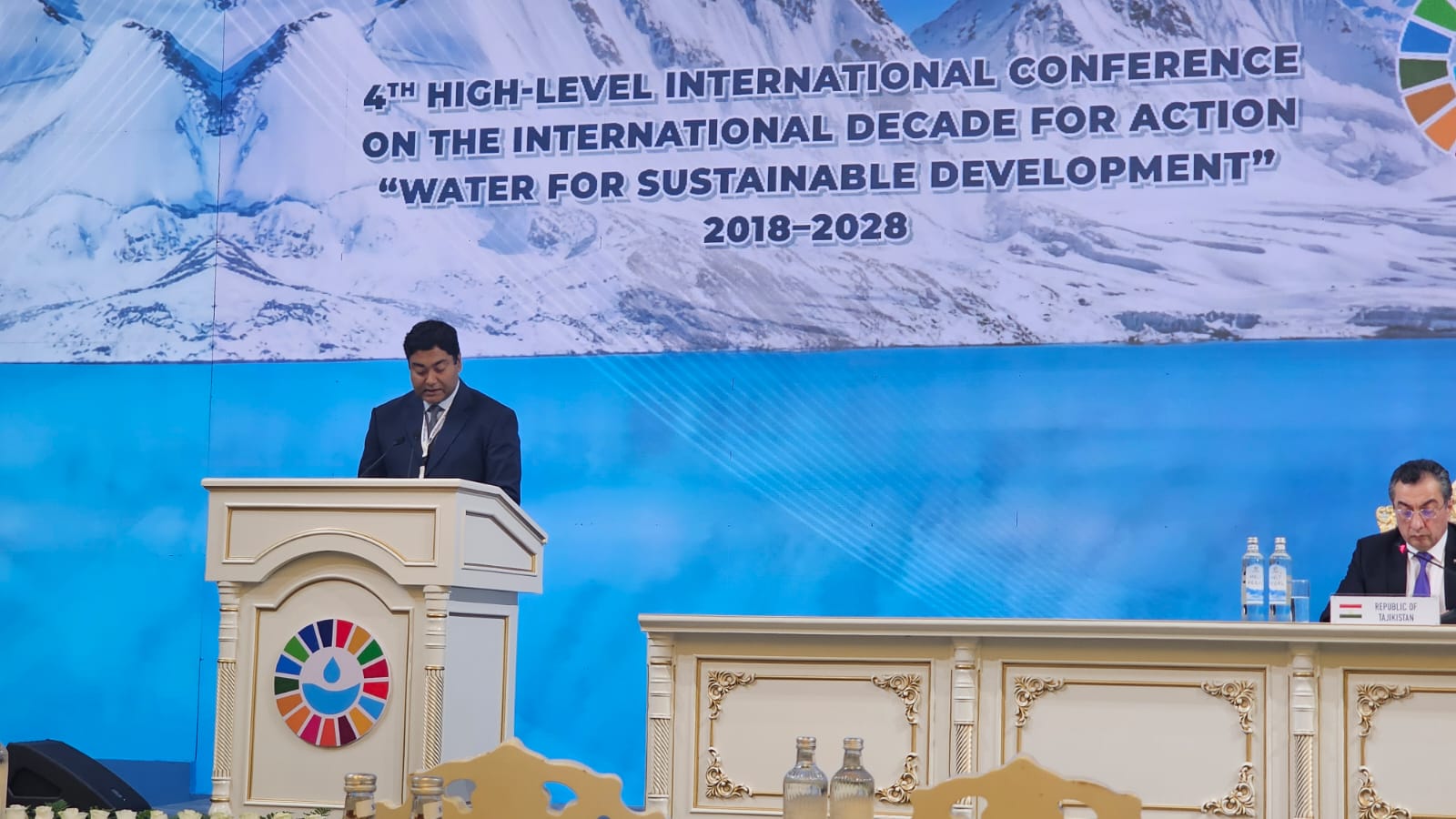
Dushanbe, 28 May 2026 – The Tajik capital closed four days of high-level deliberation at the Fourth High-Level International Conference on the International Decade for Action “Water for Sustainable Development” 2018–2028, which brought together approximately 2,500 participants from 110 countries.
Water Operators' Partnerships: A Framework for South-South Solidarity
On 25 May, GWOPA/UN-Habitat co-organised a side event on South-South and Triangular Cooperation, alongside the Government of Tajikistan and the UN Office for South-South Cooperation (UNOSSC). The session challenged a longstanding assumption embedded in international development practice: that solutions travel from North to South.
Experience shared in the room painted a different picture: the Global South is facing some of the most severe water-related pressures on earth while also producing some of the most contextually relevant, cost-effective and scalable responses to them.
South-South and triangular cooperation, anchored in solidarity, peer-to-peer learning, and respect for local knowledge, was discussed as a framework well suited to that reality, with Water Operators' Partnerships highlighted as a proven vehicle for translating these principles into on-the-ground improvements in service delivery.
“The Global South is facing some of the most severe water-related pressures on earth while also producing some of the most contextually relevant, cost-effective and scalable responses to them.”
Locally Governed Resilience: The Asia-Pacific Contribution
The Asia-Pacific Regional Preparatory Meeting for the 2026 UN Water Conference was also part of the Conference, held on 25 May and hosted by ESCAP, serving as a regional bridge to the Dushanbe discussions.
UN-Habitat’s contribution, Water for People in Practice: Locally Governed Resilience Systems from Asia-Pacific, emphasised that water security is not only an infrastructure challenge, but also a human settlements, local governance and resilience challenge.
Drawing on experiences from Afghanistan, Sri Lanka, Cambodia, Pakistan, Lao PDR and Iran, the session highlighted practical approaches that start with people and risk, respond to settlement realities, connect water, sanitation, drainage and land use, and build local governance, financing and maintenance into investments from the outset.
Its outcome message was clear: as the region prepares for the 2026 UN Water Conference, scalable water solutions must be locally governed, gender-responsive, climate-resilient and capable of reaching the people and places most at risk.
Water Reframed: From Environment to Security
A defining thread running through the conference was a deliberate reframing of what water means in the contemporary geopolitical moment, marking a shift in how water security is understood at the highest levels of international policymaking.
For decades, water has been treated primarily as an environmental or humanitarian concern, important and yet sectoral. What emerged from Dushanbe is a more demanding consensus: that access to water and sanitation is inseparable from economic stability, food and energy security, and ultimately, from peace.
The conference was equally notable for institutionalising inclusion rather than merely signalling its importance. Parallel forums for youth, women, and the private sector, with particular focus on African business engagement, ran alongside the main programme.
The Women and Water Forum produced a dedicated declaration and announced the launch of a new partnership network, accompanied by a regional action plan intended to carry its commitments forward into the 2026 UN Water Conference.
The message was unambiguous: gender-responsive water governance is not a thematic supplement; it is a prerequisite for effective policy.
The Dushanbe Conference was one of the final high-level preparatory gatherings before the 2026 UN Water Conference. It produced a substantive package for negotiators and policymakers to carry forward, with the Co-chairs’ Summary feeding directly into the Abu Dhabi preparatory process.