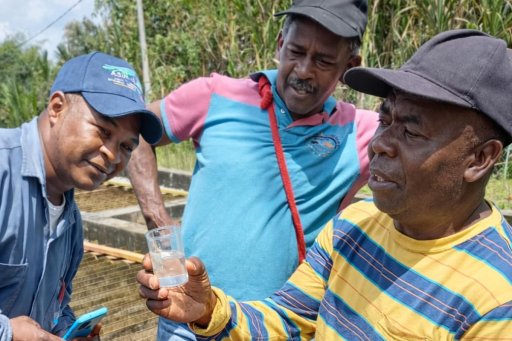
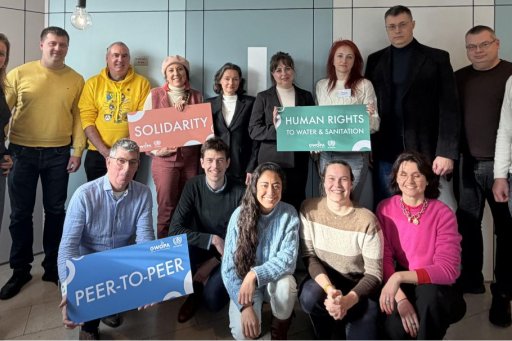
In the industrial city of Gabès in Tunisia, where water losses and pressure on the network affect service delivery, a four-year Water Operators’ Partnership between Tunisia’s National Water Distribution Utility (Société nationale d’exploitation et de distribution des eaux, SONEDE) and Italy’s MM S.p.A. has come to a close. The partnership, managed through the Global Water Operators’ Partnerships Alliance, hosted by UN-Habitat, and funded by the European Union, supported work on leak detection, digitalization, urban drainage and participatory governance.
For technicians on the ground, the gains were concrete. Acoustic correlators, noise loggers and utility locators introduced through the partnership gave SONEDE teams in Gabès more precise ways to detect underground leaks, while training in July 2024 helped staff from regional and national offices put the tools into daily use. A Geographic Information System pilot and the distribution of 17 industrial-grade tablets also strengthened field data collection and real-time decision-making.
“Before, finding underground leaks could take too much time and too much guesswork,” Hana Jridi, Head of District Operations of SONEDE said. “Now our teams can intervene faster and with more precision, and that means less water lost.”
But the partnership’s footprint extends beyond maintenance practice. Over the course of the initiative, 19 community workshops and 18 roundtables with businesses brought more than 670 participants into discussions on water use and local responsibility. That process culminated in a Responsible Water Use Charter endorsed by 250 stakeholders, creating a shared local framework for more participatory water governance.
“What changed was not only the technical capacity,” Mohamed Chérif, Secretary-General of Tahar Gabès Municipality highlighted. “The partnership helped connect the utility, the municipality and the community around a common understanding that water governance is everyone’s business.”
That is also where the partnership’s gender significance is most visible. In water-stressed settings, women often experience the daily effects of unreliable or unequal services most directly, yet their perspectives are frequently less present in formal decision-making. By widening discussions beyond technical institutions and opening space for citizens, community actors and businesses, the Gabès partnership helped make water governance more inclusive and more closely tied to everyday life.
“When people are invited into the discussion, water stops being just a technical issue,” Afef Nasri from the local NGO Union Tunisienne de Solidarité Sociale noted. “It becomes a question of fairness, daily life and whose voice counts.”
The partnership also laid the groundwork for cooperation beyond its formal end. The two utilities signed a long-term memorandum of understanding and developed a joint feasibility plan on digitalisation, pointing to a relationship intended to continue after closure.
“What stood out in Gabès was that the technical work was strongest when it was matched by dialogue with the community,” Emi Colombo, Head of International Relations of MM S.p.A. said. “You can improve systems, but lasting change happens when institutions and citizens move together.”
For Gabès, the legacy is visible in better leak detection, stronger digital management and a pilot drainage intervention designed to reduce the effects of heavy rainfall. Less visible, but possibly more lasting, is the shift in how water is discussed: not only as an operational challenge for utilities, but as a shared public concern shaped by participation, accountability and inclusion.