Climate change is experienced most directly through water, whether in the form of droughts, floods, water scarcity, or service disruptions. Resilient water and sanitation services, watershed protection, and nature-based solutions are essential for adaptation, while energy-efficient utilities, improved wastewater treatment, and safe faecal sludge management can also contribute to cut emissions reductions.
Countries should make water and sanitation an explicit, costed, and financed component of their Nationally Determined Contributions (NDCs) 3.0 and National Adaptation Plans, in line with the water target of the Global Goal on Adaptation. Local governments and water operators should be recognized as strategic implementation partners. Finance, technology, capacity-building, and enabling policy frameworks must reach them. Water Operators' Partnerships (WOPs) offer a proven approach to strengthen utilities’ capacity to deliver climate resilient services.
At the "Implementation COP" starting in Antalya, Türkiye from 9 to 20 November, the question is no longer whether water features in climate plans, but whether commitments are delivered. As the Road to Abu Dhabi gathers momentum and preparations continue for the 2026 UN Water Conference, water-sensitive urban design and circular water solutions are vital levers for localizing Sustainable Development Goal (SDG) 6 and building resilience across urban and rural systems.
Why COP31 matters for water and sanitation
COP31 will be giving water and sanitation more space on the climate agenda than any COP before it. For the first time, sanitation sits within a COP Presidency priority: Activation Group 14 of the COP31 Action Agenda covers resilient water management and sanitation. The Global Goal on Adaptation’s water target, established under the UAE Framework for Climate Resilience, and the Belém Adaptation Indicators adopted at COP30 have strengthened the recognition of water and sanitation within global climate action.
Yet the gap remains large: a 2024 Stockholm Environment Institute (SEI)– Sanitation and Water for All (SWA) analysis of 144 countries' NDCs found sanitation and wastewater made up only about 2% of identified activities, and the annual spending gap to reach SDG targets 6.1 and 6.2 is estimated by the World Bank at USD 131–141 billion. With countries submitting their NDCs 3.0, COP31 is the moment to turn water commitments into financed, locally delivered action, leading into the UN Water Conference in December.
UN-Habitat's analysis of 115 NDC 3.0 submissions, covering 142 Parties, shows how far commitments still are from delivery. Water is a core theme in 86% of NDCs 3.0, and 57% include urban water content, a 25% increase since the previous round. Yet only 35 NDCs back urban water with a clear plan or framework, and only 40 set out means of implementation at the urban level. Just 15 reference local governments, and only four mention water utilities, the very institutions that will deliver this action on the ground.

What is in COP31 for water and sanitation utilities?
Utilities are where national climate plans become real services, and COP31 is the moment to make sure they are treated as delivery partners rather than an afterthought. As countries decide who will deliver their NDCs 3.0 and adaptation plans, utilities must have a strong presence at the global forums such as COP31, to be named in plans, budgets, and investment pipelines as implementing actors. Parties, development partners, civil society, private sector, vertical climate funds and donors at COP31 are discussing how finance can reach local actors, giving utilities a chance to make the case for mechanisms that reach them directly.
Water Operators' Partnerships (WOPs) demonstrate how peer-to-peer cooperation between utilities can strengthen operational capacity, accelerate climate adaptation and improve access to finance for resilient infrastructure investments. COP31 further supports these efforts by bringing utilities into contact with technologies and partners for digital monitoring, early warning systems, data-driven planning and nature-based solutions.
Utilities are also indispensable in climate mitigation efforts, by cutting emissions through energy efficiency, lower water losses and better wastewater and faecal sludge management, which can open doors to mitigation finance.
GWOPA at COP31
Global Water Operators’ Partnerships Alliance (GWOPA) will as part of UN-Habitat and with partners contribute to five COP31 Blue Zone sessions showcasing how water operators, local governments and development partners can accelerate climate resilience through collaboration, capacity development and investment.
GWOPA is once again co-organizing the Urban Water Resilience and Local Climate Action Day at the Water for Climate Pavilion, together with ICLEI. The Pavilion is coordinated by SIWI and brings together more than 90 organizations to give the water community a stronger, shared voice in climate negotiations. GWOPA has been a core partner of the Pavilion since COP26.
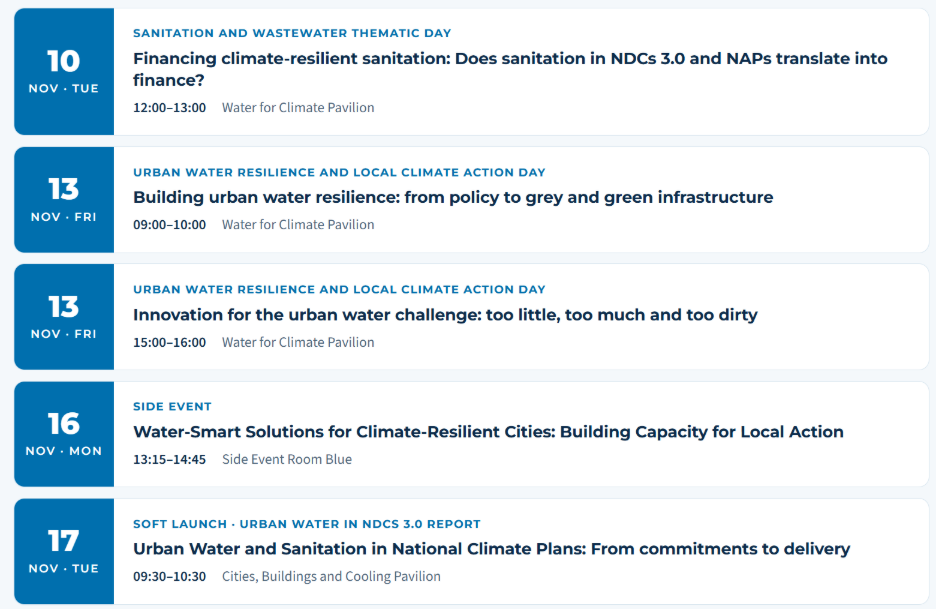
Join us in Antalya and online
Join us in the Blue Zone if you are attending COP31. We welcome the opportunity to connect and ensure that your utility's experience and priorities help inform the global conversation on climate-resilient water and sanitation services.