Well-managed urban growth is key to preventing and reversing land degradation. This is nowhere more urgent than in drylands, where over 90% of the world's dryland settlements sit in developing regions and scarcity, erratic rainfall and groundwater over-extraction already threaten hundreds of millions of people.
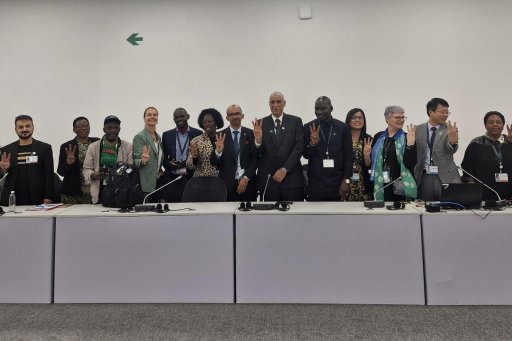
In Ulaanbaatar, UN-Habitat's Global Water Operators' Partnerships Alliance (GWOPA) is bringing cities and utilities into the land agenda at the 17th session of the UNCCD COP. COP17 offers GWOPA a timely platform to show how Water Operators' Partnerships and city-level action can strengthen land and water resilience on the ground.
Cities and territories are not peripheral to the land agenda. They are where decisions on land consumption, housing, infrastructure, urban-rural linkages, migration and ecosystem protection converge. Across 781 cities in 123 countries, urban land consumption has outpaced population growth since 2000, making peri-urban areas and hinterlands the decisive frontline for Land Degradation Neutrality. Mayors and local governments are land stewards, and utilities are the institutions that make water resilience real on the ground.
GWOPA co-hosts two side events on COP17 Water Day, 25 August.
🔹 Preventing Water Bankruptcy: Cities, Utilities and Catchments on the Frontline of Drought Resilience (14:00–15:30, Room 23 | GWOPA/UN-Habitat & ICLEI)
A landmark UN report confirmed in January 2026 what operators have long seen coming: many basins and aquifers are shifting from temporary scarcity into chronic "water bankruptcy". By 2030, an estimated 700 million people may be displaced by drought, a reminder that COP16 Decision 23 rightly recognises drought and land degradation as drivers of displacement. This session puts practitioners first: early warning signs, non-revenue water reduction, nature-based and catchment-scale solutions, and investment readiness.
🔹 Transitioning to Circular Water Management for Climate-Resilient Cities and Communities in Drylands (18:00–19:30, Room MET-05 | UNESCO IHP, Water Authority of Mongolia & GWOPA/UN-Habitat)
Opened at the highest level, Mongolia's Deputy Prime Minister and Minister of Environment and Climate Change, UNESCO's Deputy Director-General, and UN-Habitat's Executive Director, this event launches the ambition for a Partnership for Water in Dryland Cities, and showcases Mongolia's "333 lakes in 333 settlements" initiative alongside experience across the globe.
Water resilience is fundamental to restoring land. Integrated water resource management, watershed restoration, wastewater reuse and water-sensitive urban design reduce land degradation, improve soil health and strengthen resilience to drought — while supporting healthier cities and stronger urban-rural linkages. On the Road to Abu Dhabi toward the 2026 UN Water Conference and the close of the Water Action Decade in 2028, these are vital levers for localizing SDG 6.
The through-line: partnership and multi-level governance. Circular water solutions are largely known. What's scarce is institutional capacity. Water Operators' Partnerships close that gap by building partnership between utilities through peer to peer, solidarity-based approach to learn and share knowledge and capacity with one another, turning global commitments into locally owned implementation.
Photo by IISD/ENB | Anastasia Rodopoulou