
The 2026 United Nations Water Conference, to be held in the United Arab Emirates from 8-10 December 2026, is structured to move beyond discussion and into accelerated, collective action toward achieving SDG 6. Co-hosted by the UAE and Senegal, the conference will serve as a critical milestone within the International Decade for Action, "Water for Sustainable Development" (2018–2028)
In the wake of the UN 2023 Water Conference and the resulting Water Action Agenda, GWOPA is scaling its efforts to ensure that water and sanitation operators are recognized as "frontline institutions" and "local-level champions" for realizing these global goals. GWOPA`s Water Action Commitment #SDGAction50781 aims to “Localize SDG 6 - Transforming Access to Water by Strengthened Capacity of Operators Closest to Water Provision.” The initiative pledges to accelerate the approach of GWOPA to engage at least 100 public water and sanitation service providers across the globe to sign up for a set of criteria for peer exchange and support.
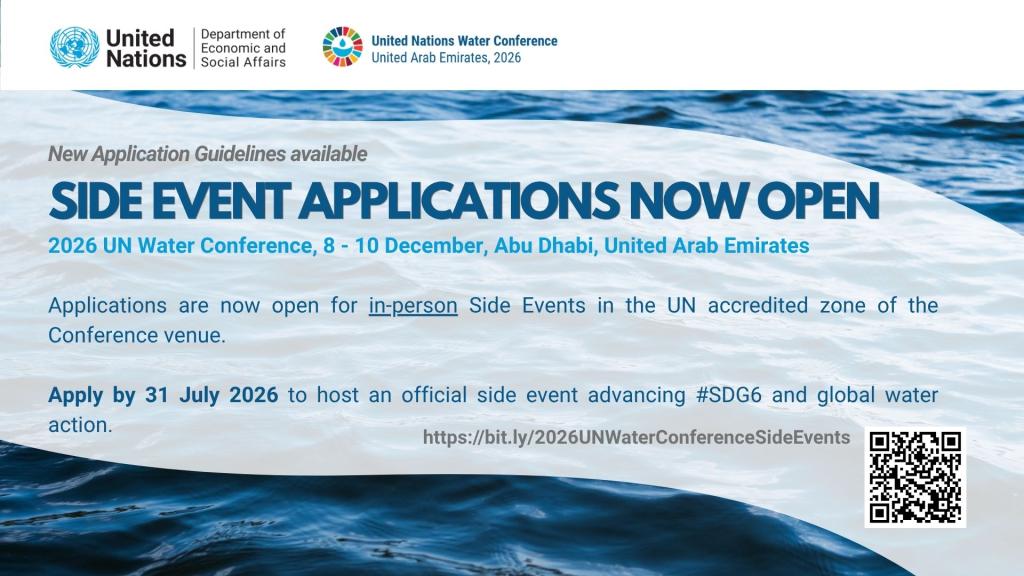
Conference organisers DESA have opened a call for in-person side events with a deadline of 31 July. More information on the conference website here. The GWOPA Secretariat is continuously updating its dedicated webpage with information and encourages members to stay informed and engaged in the political process. If you would like to collaborate with GWOPA on our messaging or events, please reach out to [email protected] with the subject line "2026 UN Water Conference."
The Six Interactive Dialogues: Our Key Messages as GWOPA/UN-Habitat
- Secure tenure enables equitable access to water and sanitation. Diverse forms of tenure should be recognized to ensure that access to safe drinking water, sanitation and hygiene (WASH) services is not dependent on formal land ownership. The Baku Call to Action calls for stronger tenure protections and community-led approaches to service delivery. UN-Habitat supported over 81,000 households to secure improved tenure between 2024 and 2025.
- Informal settlement upgrading must integrate housing and WASH. Water and sanitation are fundamental components of adequate housing and should be embedded in slum upgrading programmes and rights-based urban development approaches.
- Integrated territorial planning is essential for universal WASH access. Water and sanitation should be incorporated into urban and territorial planning alongside housing, energy, mobility and waste management. The Secretary-General's report highlights support to national urban policy reforms in more than 12 countries.
- Empowered local governments and utilities are critical. The Baku Call to Action advocates for decentralized financing and stronger local institutions. UN-Habitat's ROSRA tool helped generate over USD 49 million in local revenues in Somali cities, strengthening local service delivery.
- Climate-resilient WASH systems must prioritize vulnerable communities. The Secretary-General's report notes a resilience portfolio exceeding USD 200 million across 35 countries, while the Baku Call emphasizes resilient housing, basic services and community-led adaptation in climate-vulnerable settlements.
- Water is a foundation of urban prosperity and adequate housing. Investments in water and sanitation drive health, livelihoods, economic development and social inclusion. During the reporting period, 17.6 million people moved out of slum-like conditions with UN-Habitat support.
- Climate-resilient WASH technologies are essential for informal settlements. The Baku Call promotes nature-based, community-led and climate-resilient solutions, while UN-Habitat's Climate Proofing Toolkit helps cities integrate climate risks into WASH investments.
- A human-rights approach to water and sanitation leaves no one behind. In 2025 alone, UN-Habitat enabled 2.76 million people to access basic services, particularly clean water, including more than 205,000 residents of informal settlements across 27 cities.
- Circular economy approaches can enhance water security and livelihoods. Resource recovery, wastewater reuse and faecal sludge management can reduce pressure on freshwater resources while creating jobs and economic opportunities.
- WASH must be embedded in slum upgrading and new settlement development.The Baku Call recognizes citywide informal settlement upgrading as a critical pathway for addressing inequalities and expanding access to basic services.
- Informal settlements are at the frontline of water and climate risks. The Baku Call highlights that communities living in inadequate housing face disproportionate impacts from floods, droughts and environmental degradation.
- Climate-resilient WASH systems are a core adaptation measure. UN-Habitat's work in more than 25 crisis-affected countries demonstrates how resilient WASH infrastructure supports recovery, adaptation and disaster risk reduction.
- Integrated water governance must connect housing, land and climate action. The Baku Call promotes systems-based planning that links housing, infrastructure, services, livelihoods and environmental management.
- Closing WASH gaps reduces inequality and strengthens resilience. Informal settlement upgrading, tenure security and universal access to basic services are critical for achieving climate justice and leaving no one behind.
- Nature-based solutions should benefit vulnerable communities. UN-Habitat's Nature-based Solutions Playbook supports ecosystem restoration, flood prevention and water security while improving living conditions in informal settlements.
- Informal settlements must be recognized as key water governance stakeholders. The Baku Call promotes community-led participation and recognizes local communities as co-creators of solutions.
- Water insecurity in informal settlements is a development and peacebuilding challenge. Improving access to safe and affordable water in fragile and rapidly urbanizing regions contributes to stability, resilience and social cohesion.
- Territorial planning and data are essential for inclusive cooperation. Community-generated data, spatial planning tools and scientific cooperation help make informal settlements visible in water governance and investment decisions.
- Investing in water systems for informal settlements generates high social returns. In 2025, UN-Habitat-supported interventions significantly expanded access to clean water, while GWOPA partnerships improved services for more than 344,000 people.
- Water cooperation should move from sectoral to territorial approaches. Integrated planning that links housing, land, mobility, livelihoods and water resources creates stronger pathways for resilience and sustainable development.
- Housing, slum upgrading and WASH must be addressed together. The Secretary-General's report and the Baku Call both emphasize that access to water and sanitation is integral to adequate housing and sustainable urbanization.
- Multilevel governance is essential for the implementation of SDG 6. Local governments need stronger mandates, financing and institutional capacity to translate global commitments into local service delivery.
- SDG localization connects global targets with local action. UN-Habitat's SDG Cities network now reaches more than 300 cities in 85 countries, helping integrate water and sanitation into local planning and reporting.
- Integrated spatial planning strengthens water, climate and biodiversity outcomes. Water and sanitation should be embedded in territorial planning frameworks that connect SDGs 6, 11, 13 and 15.
- Invest in housing, informal settlement transformation and basic services as a pathway to water security - Investments in water and sanitation should be integrated with housing, land and informal settlement upgrading programmes to maximize social, economic and environmental returns.
- Strengthen municipal finance and local government capacity to expand equitable WASH services - Achieving SDG 6 requires direct investment in the financial and institutional capacity of local governments and service providers. The Baku Call to Action advocates for stronger municipal finance, fiscal autonomy and decentralized financing, while the Secretary-General's Report highlights support to local revenue reforms and strengthened governance systems.
- Scale innovation and digital technologies that reach underserved communities - Investments in innovation should prioritize technologies that improve service delivery, resource efficiency and accountability in low-income and informal settlements. Geospatial tools, digital land administration, smart utility management and community-generated data can help close service gaps and attract investment. The Secretary-General's Report highlights UN-Habitat's work on digital transformation, AI-assisted settlement mapping and urban data systems to improve planning and service delivery.
-
Invest in climate-resilient and nature-positive water infrastructure in vulnerable settlements - Water and sanitation investments should prioritize climate resilience, disaster preparedness and ecosystem restoration, particularly in informal settlements that face the highest exposure to floods, droughts and environmental degradation. The Baku Call to Action calls for climate-resilient housing and basic services supported by nature-based and community-led solutions, while the Secretary-General's Report highlights UN-Habitat's expanding resilience portfolio across 35 countries.
Strategic Milestones to 2028
A trajectory of momentum across global platforms.