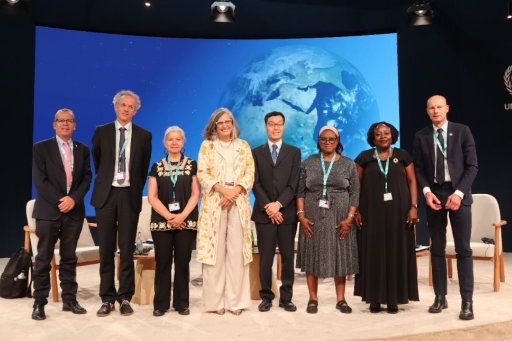
BAKU, Azerbaijan, 17 May 2026 – Water and sanitation operators stepped onto a wider urban stage as UN-Habitat’s Global Water Operators’ Partnerships Alliance (GWOPA) convened its Assembly on the opening day of the thirteenth session of the World Urban Forum.
Meeting in Baku and online, GWOPA members, partners, United Nations representatives and government officials focused on the people and institutions that keep water flowing, sanitation services running and cities functioning every day.
Rose Kaggwa, Chair of the GWOPA Assembly and Senior Director Business and Scientific Services at National Water and Sewerage Corporation Uganda – a long-standing utility practitioner – opened the session from the perspective of those working on the front line of service delivery. She stressed that housing, water, sanitation and urban resilience can no longer be treated as separate conversations.
“If we are serious about inclusive housing and resilient cities, then water and sanitation utilities must be embedded into housing, land, and urban planning discussions from the very beginning — not brought in later as an afterthought,” she said.
UN-Habitat Executive Director Anacláudia Rossbach welcomed participants at a decisive moment on the road to the 2026 United Nations Water Conference. She underlined the scale of the challenge, with billions still lacking adequate housing, safely managed drinking water and sanitation, while cities face rapid growth, climate pressures and rising demand for services.
“Implementation ultimately depends on the people and institutions that deliver services every day: capable operators, supportive policies, adequate financing and partnerships that last beyond individual projects,” she said.
Rossbach described Water Operators’ Partnerships as “solidarity in practice” – utilities working side by side to reduce water losses, prepare for emergencies and extend services to low-income communities. In 2025, GWOPA supported 42 active partnerships, contributing to improved water and sanitation services for more than 260,000 people.
Retno Marsudi, United Nations Secretary-General’s Special Envoy on Water, called for faster action as cities face growing water stress and climate risk.
“Water is the invisible foundation of urban development and water operators are the backbone of collective water action. Through GWOPA’s partnerships, they strengthen capacities, systems and institutions, helping keep cities functioning, communities thriving and development gains protected,” she said.
She urged GWOPA members to focus on resilience, bring water more fully into urban agendas and measure success by improvements in people’s lives.
Pedro Arrojo-Agudo, United Nations Special Rapporteur on the human rights to water and sanitation, called for the voices of rights-holders, municipalities, utilities and civil society to be heard more clearly in multilateral processes. He stressed that the human rights to water and sanitation must remain at the centre of global water discussions.
Sebastian Herold, Senior Policy Officer at the German Federal Ministry for Economic Cooperation and Development, reaffirmed Germany’s continued support for GWOPA and Water Operators’ Partnerships, highlighting the Alliance’s role at the intersection of SDG 6 on clean water and sanitation and SDG 11 on sustainable cities and communities.
Riad Akhundzada, Head of Strategy, International Cooperation and Science Department at the Azerbaijan State Water Resources Agency, underlined that utility cooperation is essential as service expectations rise. He pointed to Azerbaijan’s reforms to expand safe urban water and sanitation, including through digitalization.
Following the opening, the Assembly moved from vision to practice. A session reviewed 17 years of GWOPA’s work and the growth of the global WOPs movement, while looking ahead to the Alliance’s forthcoming 2026–2029 Strategy.
In fast-paced espresso presentations, GWOPA members and partners from the Asian Development Bank, Colombia, Egypt, Ghana and UNICEF brought perspectives from different regions and institutions, but converged around the same practical challenge: WOPs work, and the next task is to scale them, embed them in national systems and connect them more directly to investment, policy and capacity development.
The group discussions brought the debate closer to the realities of service delivery. Participants called for more utilities to be involved in public policy, stronger cross-sector collaboration, deeper engagement with communities, women and youth, wider use of digital tools and stronger advocacy for resources in a tightening funding environment. They also stressed that WOPs should not remain isolated partnerships, but become part of broader national and regional systems for strengthening utilities.
The Assembly also explored with members and partners what a practical, collective GWOPA roadmap towards the 2026 United Nations Water Conference, gathering input from members on how to position utilities as essential urban development partners and how the Alliance can advocate more effectively together.