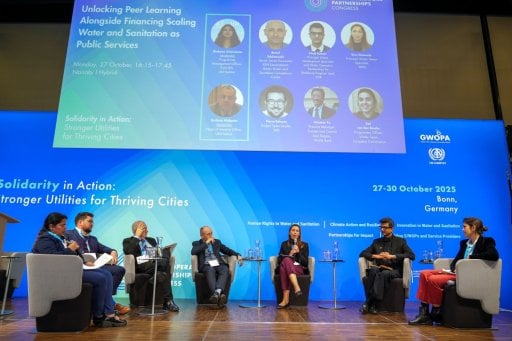
This week at the 6th Global Water Operators’ Partnerships Congress in Bonn, Germany, one message stood out: when water and sanitation utilities learn from one another through peer-to-peer exchange – Water Operators’ Partnerships and Sanitation-focused Water Operators Partnerships (WOPs and SWOPs) – solidarity becomes a driver of sustainable service delivery.
The Congress brought together close to 550 participants from over 70 countries gathered at the 6th edition of the Congress convened by the United Nations Human Settlements Programme through its Global Water Operators’ Partnerships Alliance (GWOPA), with support from the Government of Germany and the City of Bonn. The Congress brought together utility leaders, local governments, financiers, development agencies and civil-society actors united by a common goal – stronger utilities for thriving cities.
Under the theme “Solidarity in Action”, the Congress showcased how peer-to-peer cooperation is driving progress towards universal access to safe water and sanitation in over 40 plenaries and sessions over three days, followed by training and field visits on the fourth day. Participants exchanged experiences across topics of artificial intelligence and space-based data for smarter utilities to non-sewered sanitation and nature-based solutions for climate resilience. Activities offered hands-on learning opportunities, while the “Stronger Together!” coalition and women’s leadership panels underlined the importance of equity and diversity in building sustainable utilities.
‘People learn from people’ was one of the key takeaway messages that ran through all the events.
UN-Habitat Executive Director Anacláudia Rossbach opened the event with a video message noting that ‘Strong and accountable utilities are vital to building sustainable, resilient and inclusive cities. They stand at the heart of UN-Habitat’s Strategic Plan 2026–2029, which aims to ensure that every person enjoys adequate housing, land and basic services, and that cities become more inclusive, safe, resilient and sustainable’. She called for ‘enabling environments – policies, finance and regulation – that allow utilities to plan and deliver sustainably’.
Germany’s State Secretary for Economic Cooperation and Development, Niels Annen, emphasised that “Human rights require global solidarity, especially the right to water and sanitation as set out in SDG [Sustainable Development Goal] 6. Because we are convinced that without progress on SDG 6, without progress on health, education, gender equality, more will stall, Germany is unwavering in its commitment to the human rights to water and sanitation.” He also announced the launch of the Urban Water Catalyst Initiative Foundation, a new instrument to mobilise investment in utilities in the Global South.
In delivering her keynote address, UN Secretary-General’s Special Envoy on Water, Retno Marsudi urged participants to view water and sanitation as the foundation of all development – from health and education to food, energy and gender equality – and to scale up the practical solutions already proving successful on the ground. Highlighting the growing engagement of young people and local operators, she called for a new “narrative of hope, action and solutions” to guide the sector towards the 2026 United Nations Water Conference.
Human rights to water and sanitation are essential for the realization of many other human rights, including the right to life and the right to adequate housing. This was underscored in the human rights plenary with UN Special Rapporteur on the right to water and sanitation, Pedro Arrojo-Agudo, South Africa’s Minister for Human Settlements and Acting Minister for Water and Sanitation, Thembi Simelane, and Executive Secretary of United Nations Convention to Combat Desertification Yasmine Fouad.
The Congress celebrated solidarity as a powerful force for change. Water and Sanitation Operators’ Partnerships showed that transformation comes not only from finance or technology. It comes from people – utility professionals – working together across borders, sharing knowledge, skills and trust. Across continents, these partnerships have helped utilities cut water losses, improve billing systems, extend sanitation networks and reach unserved communities. They have strengthened leadership, innovation and institutional culture.
The Congress saw the release of new partnerships, tools and initiatives designed to help utilities scale up their performance as frontline actors in delivering on the SDGs. The EU-funded Water Operators’ Partnerships (EU-WOP) Programme shared results from its first phase and announced new partnerships to expand peer learning across Africa, Asia and Latin America.
Moderating the closing ceremony, Rose Kaggwa of Uganda National Water and Sewerage Corperation and Chair of the GWOPA Assembly, called upon all participants to take inspiration with them as they return home. Speakers included GWOPA Steering Committee members David Boys of Public Services International; Esther Ngugi of Nyeri Water and Sanitation Company, and Syed Zahid Aziz of Pakistan Water Operators Network in an inter-generational dialogue. Rose Molokoane ofSlum Dwellers International called for practical action.
Acting Chairman of United Water Supply Service of Large Cities of the State Agency for Water Resources of Azerbaijan, Tahir Khalilov called upon utilities and Congress participants to convene at the World Urban Forum in May 2026 and to ensure that urban basic services, such as water and sanitation, are elevated into the discussions. The Congress also formed an important milestone in the lead-up to the UN 2026 Water Conference where water and sanitation service providers will play a critical role in raising the urgent need of delivering essential services in cities.
Åsa Jonsson, Head of GWOPA at UN-Habitat, closed the Congress with an emphasis on the growing strength of the Alliance and the demonstrated interest and engagement in Water and Sanitation Operators’ Partnerships, seen through the continued engagement by participants right until the end of the Congress. She urged participants to continue to “refine the art of partnership” and turn dialogue into tangible results
The GWOPA Secretariat expresses its appreciation to all participants for the active engagement at the Congress and looks forward to the continued partnerships!