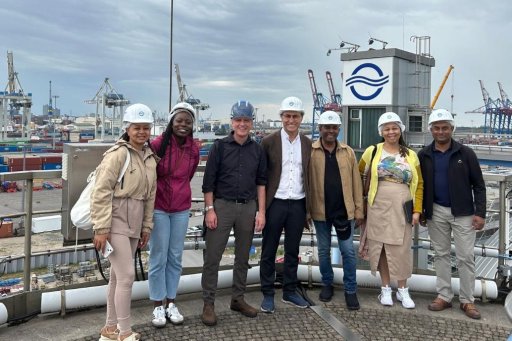
Noordwijk, Netherlands, 12 May 2026 – The water and space technology sectors came together at the European Space Agency’s European Space Research and Technology Centre in Noordwijk, to explore how space-enabled solutions can help address some of the most pressing challenges facing water and sanitation service providers.
The ESA Business Applications and Space Solutions Water Day brought together more than 100 participants, including technology developers, water service providers and other stakeholders from the water and innovation sectors. The event focused on how technology and space-based applications can support responses to water scarcity, climate change and related challenges. It also provided a platform for networking, showcasing ESA Business Applications and Space Solutions-supported projects and opening new opportunities for collaboration. For many water and sanitation utilities, space may seem a distant place to look for practical solutions. Yet the discussions in Noordwijk showed that space-enabled technologies can support very concrete operational needs. These range from geographic information system mapping of networks and remote leak detection to artificial intelligence-supported systems for calculating emissions from water storage facilities and tools to inform investments in nature-based infrastructure.
“These applications are particularly relevant as utilities face growing pressures linked to climate change, water scarcity, energy use and resource efficiency. Space-enabled data and digital tools can help operators make better management decisions around water sources, distribution networks, wastewater and sludge treatment, reuse opportunities and the energy performance of their systems,” said Julie Perkins, who manages the European Union Water Operators’ Partnerships Programme at GWOPA/UN-Habitat.
“There are solutions here I never in a million years would have come up with myself,” said Marcus Chenevix-Trench of Green Sea Finance, reflecting on how innovation can emerge when people of different expertise come together around shared problems.
Giorgos Sachinis, Director of Strategy and Innovation at EYDAP, the public water utility serving Athens, Greece, said the collaboration with space technology providers opened up a wide range of possibilities for water utilities. Asked what kinds of space-enabled solutions he would like to see developed, he pointed to a long wish list of operational needs. “There are so many things that could help us,” he said.
Participants also underlined that innovation must respond to the needs of people and institutions, not only to technical possibilities. Space-enabled solutions can support better decision-making on green investments and help democratise water governance when developed with the communities and operators they are meant to serve.
“Innovation needs to be built with, not for, society,” said Maria João Rosa, Head of the Urban Water Unit at Portugal’s National Laboratory for Civil Engineering.
The Water Day also offered a reminder that innovation in the water sector often requires new forms of collaboration. Utilities tend to work in risk-sensitive environments where reliability, public accountability and affordability are essential. New solutions must therefore be practical, trusted and adapted to the realities of service providers.
“The water sector is inherently conservative,” said Antonio Lastra, Innovation Director at Canal de Isabel II, Madrid, Spain. “If it were up to us to get to Mars, it would take us a while,” he added, gesturing to equipment used to explore the red planet on display in the ESA conference room. Working together, he added, can open up new possibilities.
During the event, ESA Business Applications and Space Solutions presented upcoming opportunities for European industries interested in developing solutions for the transformation of the water sector. The Water Day also builds on a wider collaboration between ESA and UN-Habitat on space-enabled solutions to urbanization challenges.
The event kicked off the Digitalization of the Water Sector Call for Proposals, opened by ESA BASS in collaboration with UN-Habitat's Global Water Operators’ Partnerships Alliance. The call invites technology developers to work with water practitioners in developing solutions to help ensure that “water is abundant, safe, affordable and used more efficiently,” said Beatrice Barresi, Senior Sustainable Applications Officer at ESA.
Over the coming months, GWOPA/UN-Habitat will help facilitate exchanges between operators in its network and technology developers interested in co-developing and piloting solutions. These collaborations are expected to support new ways of understanding and overcoming the water and sanitation challenges faced by utilities.
This initiative also links to the European Union Water Operators’ Partnerships Programme, managed by GWOPA/UN-Habitat, which includes a strong focus on digitalization in its current phase. GWOPA/UN-Habitat aims to support practical, scalable and locally relevant solutions for water and sanitation service providers.
Utilities interested in contributing to the co-development and piloting of solutions are invited to join the upcoming webinar on 20 May for further information and express their interest through the dedicated ESA webpage.